


The New Deco

Updated on: September 9, 2026

Why a Century-Old Design Movement Feels Fresh Again
Step into a beautifully designed hotel lobby, restaurant, or home today, and you may notice something familiar. Curved furniture. Rich wood grain. Ribbed detailing. Warm metallic accents. A sense of glamour that feels sophisticated rather than flashy.
While these elements feel perfectly suited to contemporary interiors, many trace their roots to Art Deco, one of design's most influential movements, nearly a century ago.
Originating in the 1920s and flourishing through the 1930s, Art Deco reflected an era of optimism and innovation. It was the age of jazz clubs, ocean liners, skyscrapers, and new technologies. Designers embraced modern materials while celebrating craftsmanship, creating interiors filled with geometric patterns, luxurious woods, polished metals, and elegant curves.
A century later, we're seeing many of these same ideas return as thoughtful reinterpretations for modern living.

Why Art Deco Feels Relevant Again
Design trends often move in cycles, and today's renewed interest in Art Deco may be a response to what came before. For more than a decade, interiors were dominated by cool grays or beige, minimal styling, and highly edited spaces. While those aesthetics remain influential, many homeowners are now seeking something warmer and more personal. They want homes with character, texture, and a sense of individuality.
At the same time, social media and hospitality design have exposed consumers to a broader range of interiors than ever before. Boutique hotels, destination restaurants, and luxury resorts have become powerful sources of inspiration, introducing richer materials and more layered environments into mainstream design conversations about our homes.
Art Deco offers an appealing middle ground between minimalism and maximalism. It celebrates beauty and craftsmanship without feeling overly traditional. It embraces luxury while remaining modern. Perhaps most importantly, it reminds us that interiors can be both functional and expressive.

Curves Are Back
One of the most visible ways Art Deco is influencing today's interiors is through the return of curves.
After years of sharp lines and angular forms, designers are softening spaces with rounded furniture, curved millwork, arched mirrors, and globe lighting. Sofas feature sweeping silhouettes, and chairs embrace sculptural forms. Even kitchen islands and built-in cabinetry are beginning to incorporate softened corners and curved edges. These details create a sense of movement and comfort while adding visual interest to the room.
The result feels both welcoming and sophisticated—qualities that made Art Deco interiors so appealing nearly a century ago.

The Return of Beautiful Wood
Nowhere is Art Deco's influence more evident than in today's renewed appreciation for richly figured woods.
The original movement celebrated exotic veneers, bird's-eye maple, burl woods, walnut, and highly crafted surfaces that showcased the beauty of natural materials. These woods weren't merely structural; they were decorative elements that brought warmth, depth, and visual richness to interiors.
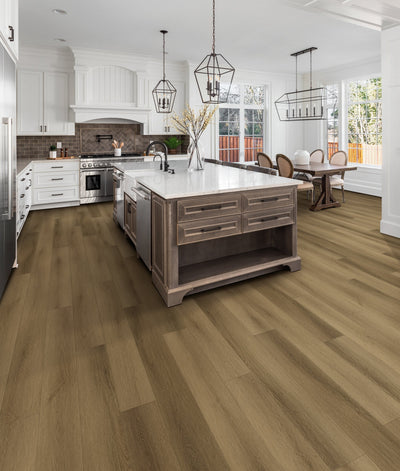
Today's designers are embracing a similar philosophy. Whether through furniture, cabinetry, wall treatments, or flooring, homeowners are increasingly drawn to natural materials that showcase authentic grain patterns and variation. Rather than seeking perfectly uniform surfaces, many are opting for finishes that celebrate wood's unique character.
This shift reflects a broader desire for interiors that feel collected, layered, and connected to craftsmanship.

Pictured above: Mocha Oak
Ribbed, Fluted, and Tambour Details
Another Art Deco influence emerging throughout today's interiors is the use of ribbed and fluted surfaces. From kitchen islands and bathroom vanities to furniture and architectural millwork, vertical detailing has become a defining design trend. These textured surfaces add dimension without overwhelming a space. Light plays across the grooves, creating subtle shadows and movement throughout the day.
While the look feels distinctly contemporary, its origins can often be traced to the decorative detailing and streamlined forms of Art Deco and its close cousin, Streamline Moderne. Like many successful design revivals, the appeal lies in adaptation rather than in imitation.

Warm Metals and Quiet Luxury
Art Deco has long been associated with glamour, but today's interpretation is more restrained. Rather than highly polished chrome and dramatic ornamentation, contemporary interiors often feature aged brass, brushed gold, bronze, and mixed-metal finishes. These accents add warmth and refinement without dominating a room.
The effect closely aligns with the concept of "quiet luxury," which has influenced both fashion and interiors in recent years. Quality materials, thoughtful detailing, and enduring craftsmanship take precedence over excess.
In many ways, this may be Art Deco's most enduring legacy: the belief that beauty lies in exceptional materials and carefully considered details.

Savannah's Modern Deco Inspiration
During a recent visit to Savannah, Georgia, I was struck by how thoughtfully several hospitality spaces were reinterpreting Deco influences for a contemporary audience.
At The Grey, housed in a restored 1938 Greyhound bus station, the original architecture offers an authentic connection to the period. Rich wood finishes, elegant curves, warm metals, and carefully layered materials show how historic influences can feel entirely contemporary when thoughtfully executed.

Nearby, Hotel Bardo offers a different interpretation. Although not an Art Deco building, its interiors incorporate many of the qualities that define today's modern Deco aesthetic: sculptural forms, textured surfaces, rich materials, and a sophisticated sense of glamour. The spaces feel luxurious yet approachable, embracing warmth over formality.
Neither property attempts to recreate the past. Instead, both illustrate how enduring design ideas can be adapted to contemporary lifestyles and expectations.
Looking Back to Move Forward
The best design movements never truly disappear. They evolve. A century after Art Deco captured the optimism of a rapidly changing world, its influence can still be seen in the curves, materials, craftsmanship, and subtle glamour shaping today's interiors. Rather than recreating the past, designers are borrowing its most enduring ideas and adapting them for modern living.
The result isn't a return to Art Deco. It's the emergence of a new Deco—one that feels perfectly at home in today's interiors.

You might like
-

Ember OakComfort
$7.49/SF* -

Marquina NeroFlex 12in x 24in
$8.49/SF* -

Mocha OakComfort NE+
$7.99/SF*


You might be interested in