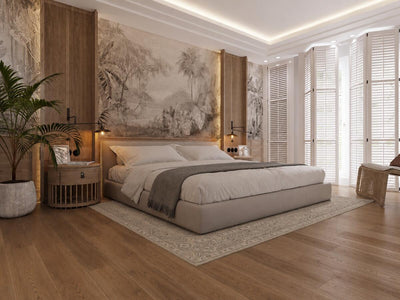



The Sound of Silence - How to Make Your Rooms Quieter

Updated on: March 31, 2026
There is a new must-have at the top of everyone’s wishlist, especially if they have children and pets: Silence.
As our homes become multi-functional hubs for work, family, play, and rest, we expect more out of our homes and that includes our floors. Quiet flooring is no longer a nice to have, but a must. At Canopy Floors, we know that a beautiful room isn't truly comfortable if it sounds like a basketball court every time the dog runs across the hallway.
If you’re wondering how to make rooms quieter, the answer starts from the ground up. Let’s explore why quiet flooring is the secret weapon of the personalized home.

3 Reasons Why Modern Homes Have a Noise Problem
The Open Concept Layout
The problem of the noisy home is partially a result of the architectural shift from siloed rooms made for various activities, towards an open-concept layout. This means fewer walls to catch and dampen noise.
Easy to Maintain Hard Surfaces
The second, is the desire to have homes that match our busy lifestyles. Homeowners shifted to hard-surface options in order to accommodate their growing families, pets, and limited cleaning time. From quartz countertops to minimalist flooring, before you know it, your entire home has become an echo chamber where sound waves bounce rather than being absorbed.
Furthermore, many new builds utilize engineered structural materials that, while sturdy, can act like a giant drum, vibrating and amplifying every footstep or dropped toy throughout the entire house. Without the "soft" buffers of the past, like wall-to-wall carpeting and heavy drapery, the modern home can ironically become an acoustic nightmare.
If You Love the Modern Look but Hate the Noise, Consider Canopy
When homeowners ask us how to make rooms quieter, they are usually dealing with two types of noise:
- Impact Noise: The "thud" of footsteps or a dropped toy.
- Ambient Noise: The echo of voices, televisions, or music bouncing off hard walls and floors.
Your home should feel cozy and intimate, not loud and hollow. This is where your choice of flooring material makes all the difference and where Canopy’s luxury vinyl floors shine!
The WPC Advantage: Why Thicker is Quieter
If you’ve been shopping for floors, you’ve likely seen the debate between WPC (Waterproof Polymer Composite) and SPC (Stone Plastic Composite). While some retailers push thin SPC for its "hardness," that hardness comes with a noisy price tag.
- The SPC Sound: Because SPC is dense and thin, it tends to be "clicky." It amplifies the sound of high heels or pet nails, creating a sharp, distracting noise. There are some high-quality SPC options on the market, but we love WPC.
- The Canopy WPC Sound: Our Comfort and Comfort Premium lines are built with a thicker WPC core. This core contains microscopic air pockets that act as a natural shock absorber. It doesn't just resist water; it "swallows" sound, providing that library-quiet feel that defines quiet flooring.
Luxury Vinyl Cork Underlayment: The Silent Partner
At Canopy, we don't just stop at a thick core. To truly master the art of quiet flooring, we’ve integrated Luxury Vinyl Cork Underlayment into our planks.
Why cork?
- Natural Sound Dampening: Cork is one of nature’s best acoustic insulators. It breaks up sound waves before they can travel through the floor and into the room below.
- Antimicrobial Protection: In the year of the "Healthy Home," cork is a superstar. It’s naturally resistant to mold and mildew, ensuring your quiet home is also a healthy one.
- The Barefoot Test: Cork provides a thermal barrier, meaning your floors stay warmer in the winter. Combined with the WPC core, it offers a cushioned "ride" that is easy on your joints and even easier on your ears.
3 Non-Flooring Tips on How to Make Rooms Quieter
Beyond choosing the right floor, here is how you can further personalize your sanctuary for maximum peace:
- Layer with Intention: Layering natural-fiber rugs (using vinyl-safe felt pads, of course!) adds an extra layer of sound absorption.
- Soften the Vertical Surfaces: Take advantage of the textile trend. Textile wall hangings and tapestries aren't just art; they are acoustic panels in disguise.
- Mind the Transitions: Use our color-matched stairs and trim to ensure there are no hollow gaps or loose transitions. A well-fitted floor is a quiet floor.
Hear & See the Difference with Canopy Floors

We believe beautiful homes start with the floor, but they are sustained by the peace and quiet they provide. A quiet floor is one that allows you to enjoy the "lived-in" moments—the late-night kitchen chats, the kids playing, the dog's happy greeting—without the headache of excess noise.
Order a Sample to feel the WPC core and cork underlayment for yourself, or Find a Local Retailer to experience Canopy Floors in person. We believe beautiful homes start with the floor.
You might be interested in