


How to Coordinate Vinyl Floors to Existing Hardwood

Updated on: August 31, 2026
You might have stunning, original hardwood in your formal living room but need something more resilient for the high-traffic "wet zones" like the kitchen, mudroom, or basement. The challenge? Making sure your new luxury vinyl doesn’t look like a "cheap imitation" of wood sitting next to the real thing.
In a perfect world, we would remodel an entire home at once so all finishes coordinate and feel cohesive. But in reality, these projects are often financially and logistically unattainable, so renovations tend to happen room by room over time. More often than not, especially in today’s housing market, people are buying older homes and are left working within the material choices of previous owners. As a result, home updates typically happen in phases—not as full-home transformations.
We’re here to help the dilemma. Now it's important to understand that it is not possible to match your existing hardwood, and definitely not recommended to try. We will dig into why we do not recommend below. Canopy Floors and our partner retailers can help recommend a complimentary floor to your existing hardwood that fits your family's needs and elevates your home.
Table of Contents
- How to Coordinate Existing Hardwood Floors to New Vinyl Flooring
- Technical Secrets for a Seamless Transition from Hardwood Flooring to Vinyl
- Why LVP is the Best Partner for Hardwood
- Bring One of Our Samples Home Today! Order Online or Visit Your Nearest Canopy Retailer
How to Coordinate Existing Hardwood Floors to New Vinyl Flooring

The Golden Rule: Coordinate the Tone
The biggest mistake homeowners make is trying to find an identical match. Because natural wood has infinite variation, a "near miss" can actually stand out more than an intentional contrast. In 2026, the secret to a visually beautiful transition is aligning the undertones.
- Identify the Undertone: Does your existing hardwood lean warm (red, orange, yellow) or cool (gray, taupe, brown)?
- The Canopy Strategy: If you have golden oak floors, look for a Canopy LVP with similar honey-colored depths, even if the grain pattern is slightly different. When the "temperature" of the two floors compliment, the eye perceives them as part of a similar design family.
Embrace the "Intentional Contrast"
If you can’t find a tone that harmonizes, contrast! In the era of curation and personalization, an intentional break in style is often better.
- The Light & Dark Play: If you have traditional mid-tone oak in the hallway, consider transitioning to a deep, moody Midnight Walnut in the study or a slate-look Canopy Flex tile in the kitchen.
- Defining Zones: Using different materials is a great way to define "zones" in a home. It tells a story of purpose—wood for comfort, vinyl for the "work" of the home.
Technical Secrets for a Seamless Transition from Hardwood Flooring to Vinyl
Coordinating the vibe is half the battle. There are many other factors to consider. Keep these technical tips in mind to ensure your transition feels intentional rather than accidental:
The Metamerism Trap: Why LVP Will Never Be An Exact Hardwood Match
Before selecting a plank, you must account for Metamerism—an optical phenomenon where two materials appear to match under one light source (like daylight) but clash under another (like LED).
Because luxury vinyl and natural wood have different "spectral reflectances," they bounce light differently.
This is why we aim for harmony over an identical match; in reality, a vinyl plank will never be a perfect twin to natural timber, and trying to force it often feels "off" when the lighting shifts. Even the same could be said about different hardwood species.
The "Flush" Factor
One reason luxury vinyl often looks "separate" from hardwood is a jarring height difference at the threshold.
Our WPC (Waterproof Polymer Composite) core is naturally thicker than most luxury vinyl, providing a more substantial profile.
This extra thickness helps bridge the elevation gap between your subfloor and your existing hardwood, allowing for a much smoother, high-end physical transition.
Mastering the Transition
How the two floors actually meet is where the magic happens. To maintain a professional look, never settle for a generic "wood-colored" strip from a big-box store that ruins the flow.
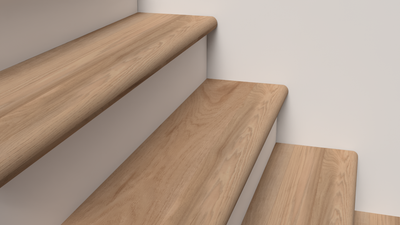
Use our color-matched stairs and trim collection to find a transition that disappears into the design.
Whether you need a slim T-molding for level floors or a reducer to bridge a slight height difference, the right trim ensures a safe, trip-free "ride" throughout your home.

Why LVP is the Best Partner for Hardwood
In the past, people worried that putting vinyl next to hardwood would devalue the home. In 2026, high-quality LVP is seen as a smart, low-maintenance, cost-effective choice.
Waterproof Security:
You get the look of wood in the bathroom or laundry room without the constant fear of a splash or spill ruining your investment.
Library Quiet:
Thanks to our Cork Underlayment, the "click-clack" of footsteps is neutralized *when our LVP is installed on a level subfloor* (see our installation guides for more information). You won't have that hollow, plastic sound when walking from your hardwood onto your Canopy floor.
Realistic Texture:
Our EIR (Embossed-in-Register) technology ensures that the grain you see is the grain you feel. When the sun hits both floors, the matte, natural finish of Canopy LVP holds its own against real timber.
Natural Edge Bevels:
Our Natural Edge and Natural Edge+ bevel technology featured on select Canopy Comfort products gives an even closer look to real hardwood with it's press edges rather than painted bevels for ultra-realism and depth. I would personally tell my friends I highly recommend considering Canopy Comfort LVP that features these bevels if looking to place LVP and hardwood within proximity to each other.
Bring One of Our Samples Home Today! Order Online or Visit Your Nearest Canopy Retailer
Altogether, the best way to incorporate new LVP flooring in your hardwood home is to see our planks directly in your lighting and space.
Order a Sample or Find Your Local Canopy Floors Retailer Today!
Our Service Areas Include (but are not limited to):
You might be interested in